Paydoly
Get started

The informal economy is already digital. It just doesn’t have the infrastructure yet.

The biggest misconception about the informal economy is that it is offline. It isn’t. Across the Dominican Republic, discovery, selling, ordering and customer service are already happening on phones. What is still catching up is the financial infrastructure underneath them.

Paydoly Insights7 min read

If you want to understand where digital commerce is heading in the Dominican Republic, do not start with an ecommerce website.

Start with a WhatsApp chat.

A customer sees a dress on Instagram. She sends the seller a direct message. The seller confirms the size over WhatsApp, sends payment instructions, waits for confirmation and arranges delivery.

Almost the entire transaction was digital.

Except the infrastructure.

There may have been no checkout. No automatic payment confirmation. No structured order record. No integrated reconciliation. No buyer protection. No connection between the conversation, the payment and the business's books.

This reveals something important:

A business can become digitally active long before it becomes digitally structured.

And much of the Dominican informal economy is already living in that gap.

01

Informal does not mean offline

The scale matters.

The Dominican Republic's 2022–2023 National MSME Survey identified more than 404,000 micro, small and medium enterprises and found that 85.2% were operating informally. The same survey estimated MSMEs at about 32% of national economic value added and 61.6% of employment.

These are not businesses waiting for the digital economy to arrive.

Many already advertise on Instagram, answer customers through WhatsApp, receive bank transfers, coordinate deliveries by phone and use social networks as their primary marketing infrastructure.

That produces a category we do not talk about enough:

the digitally informal business.

It is connected, but not integrated.

It uses technology, but often without the systems that transform digital activity into structured business infrastructure.

02

The storefront moved to the phone before the cash register did

For traditional ecommerce, the sequence is neat:

01Website02cart03checkout04payment05order record06fulfillment

Social commerce is messier:

01Instagram02WhatsApp03voice note04account number05screenshot06delivery rider07notebook

The sale still happens.

But notice how many times the transaction jumps between unrelated systems.

The customer discovers the product in one place.

Negotiates in another.

Pays somewhere else.

Proves the payment with an image.

The merchant checks another system.

Then manually remembers which payment belongs to which order.

In many cases, humans are acting as the API connecting the applications.

That is the infrastructure gap.

03

A screenshot is an astonishingly primitive bridge between two digital systems

Think about what “send me the screenshot” actually means.

A customer makes a completely digital transfer.

Then captures a picture of that digital event.

Then sends the picture through another digital application.

Then another human looks at it and decides whether to believe it.

The money moved digitally.

The proof moved manually.

There is something almost absurd about that.

And yet it happens every day because the individual technologies exist while the connective tissue between them does not.

That suggests a major opportunity for financial technology.

The next breakthrough may not require teaching small businesses an entirely new behavior.

It may simply require removing the manual work between behaviors they have already adopted.

Payment links instead of account numbers.

Automatic confirmation instead of screenshots.

Transaction references instead of memory.

Escrow where neither party knows the other.

Merchant records created automatically from the payment.

04

Digitalization can create economic memory

Cash is remarkably forgetful.

A customer buys RD$900 of products.

The merchant receives the cash.

The money enters the drawer.

Unless somebody records the transaction separately, very little remains after the moment passes.

A structured digital transaction behaves differently.

It can leave behind an amount. A time. A merchant. A reference. A customer relationship. A location. Potentially an order.

Now imagine thousands of those transactions accumulating.

The merchant is no longer simply receiving money.

The business is creating a history.

That history can eventually help the business understand itself, reconcile faster and demonstrate economic activity to others.

This becomes especially important in an economy where so many productive businesses remain difficult for formal financial institutions to evaluate.

05

Perhaps formalization happens backward

We usually imagine the path like this:

01Formalize02open business accounts03adopt software04accept digital payments

For many microbusinesses, the realistic sequence may be the reverse:

01Start selling02accept digital payments03build transaction history04adopt business tools05become easier to formalize

That distinction matters enormously.

It suggests that useful technology can be a bridge toward formalization rather than a reward granted after formalization has already happened.

A merchant may not wake up excited about “formal sector participation.”

They may care deeply about getting paid faster, not chasing screenshots, keeping track of sales, separating business money and getting access to financing.

Build tools that solve those problems and formalization can become a consequence of better infrastructure.

06

The goal should not be to destroy informality

Informal commerce survives for reasons.

It is flexible. Personal. Fast. Cheap to start.

A customer can negotiate.

A merchant can answer at 10 p.m.

A regular customer can ask for credit.

A seller can start a business with a phone and inventory instead of a full ecommerce stack.

Those characteristics are not automatically weaknesses.

The mistake would be digitizing small businesses by forcing them to behave like large corporations.

The better approach is to preserve the flexibility while removing unnecessary friction.

As explored in “Escrow for everyday commerce: trust in social-media selling,” the social-commerce problem is often not discovery. Buyer and seller have already found each other.

The problem is what happens between “I want it” and “The transaction is complete.”

07

The informal economy may leapfrog traditional ecommerce too

There is an even more interesting possibility.

Emerging-market small businesses may never follow the exact ecommerce evolution of the United States.

Many may never build elaborate websites.

The conversation may remain the storefront.

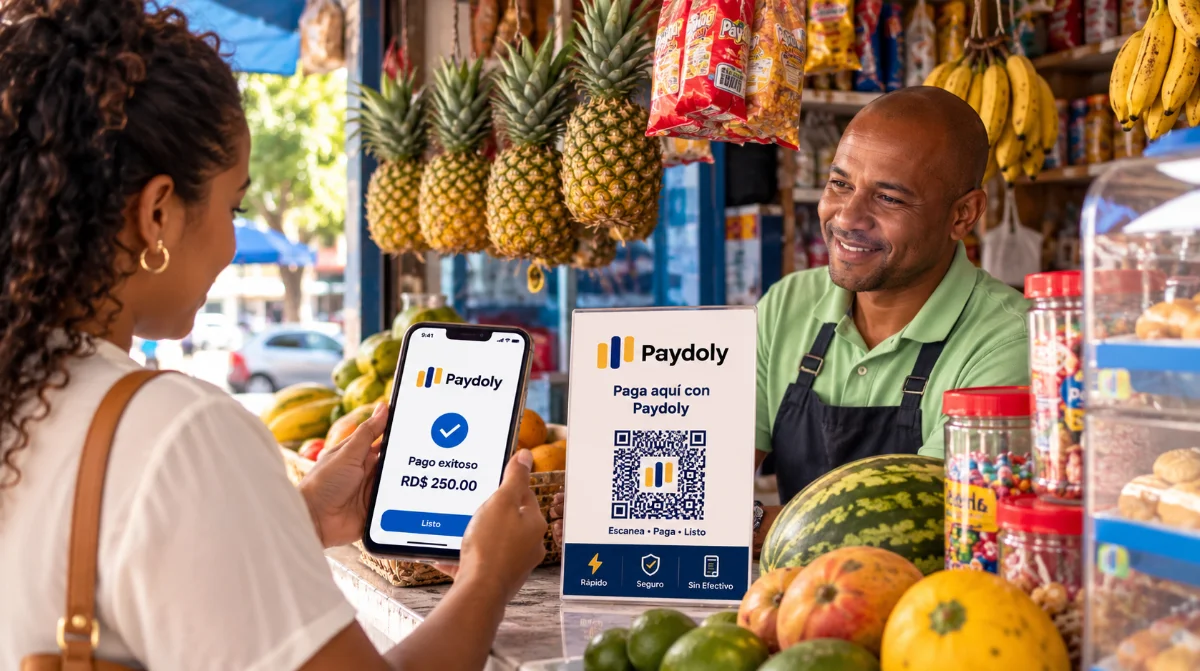
The QR code may become the checkout.

The wallet may become the cash register.

The payment history may become the ledger.

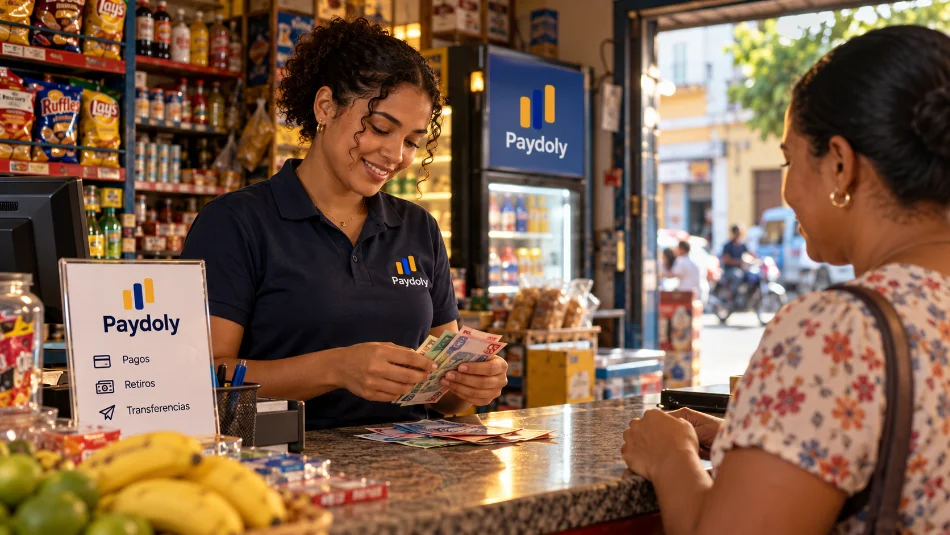
The neighborhood agent may become the bridge between physical and digital money.

That is not necessarily a primitive version of Amazon.

It is a different architecture for commerce.

And in a market built around thousands of small businesses, social relationships and mobile phones, it may actually fit better.

The informal economy does not need to be brought online. Much of it is already there. What it needs is infrastructure worthy of the commerce already happening on top of it.
Built for how you actually use your money.

Paydoly is building financial infrastructure around the way people and businesses already buy, sell and move money.

Up next

Why small businesses don’t need more payment options. They need fewer payment problems.

Fintech has spent years adding ways to pay. Small merchants are asking a much simpler question: does any of this make running the business easier?

Business · 7 min read
Blog

More from Paydoly Insights

All articles
Blog
Payments

Escrow for everyday commerce: trust in social-media selling

Much of today’s commerce starts in a chat. Escrow gives both sides a reason to say yes to someone they’ve never met.

7 min read
Insights
Business

The real cost of cash for Dominican small businesses

Cash looks free. But once you count the time spent handling it, trips to the bank, change on hand, shrinkage and lost sales, it can become one of the most expensive ways for a small business to get paid.

5 min read
Insights
Business

The payment is only the beginning

A digital payment does something cash usually cannot: it leaves behind information. For a small business, that means getting paid may eventually become the first step toward better decisions, better financing and a more powerful operating system.

8 min read
Paydoly

A financial network for the way money really moves — people, businesses and local cash agents on one balance, in pesos and dollars.

Paydoly entities
Paydoly Inc.Parent company · United States · Registered Money Services Business (MSB)
Paydoly Dominicana, S.R.L.Operating company · Santo Domingo, Dominican Republic · EPE license with the SIB in progress
Important information

Corporate structure. Paydoly Inc. is the parent company of the Paydoly group and oversees the Paydoly brand, technology platform, intellectual property, and broader group operations. Paydoly Dominicana, S.R.L. is the Dominican Republic operating entity through which applicable Paydoly products and services are made available to consumers, merchants, agents, and business customers in that market. References on this website to “Paydoly,” “we,” “our,” or “us” refer collectively to Paydoly Inc. and its applicable subsidiaries or affiliates, unless a specific entity is identified.

Financial services; not a bank. Paydoly is a financial technology and payments company and is not a bank. Paydoly does not accept deposits as a banking institution and does not pay interest on customer payment-account balances unless expressly stated otherwise for a specific product. Certain regulated financial services may be provided by Paydoly entities, licensed financial institutions, payment-service providers, or other authorized financial partners, depending on the product and jurisdiction. Customer funds are held, safeguarded, segregated, or otherwise maintained in accordance with the legal and regulatory requirements applicable to the relevant service. Any deposit-insurance protection applies only where expressly provided through an eligible financial institution and applicable law and should not be assumed solely because funds are accessible through Paydoly.

Regulatory status and availability. Paydoly products and services are offered only where legally permitted and may be subject to regulatory authorization, geographic availability, identity and business verification, eligibility criteria, transaction limits, compliance review, and approval. Certain products or features described on this website may be in development, private beta, pilot, limited release, or not yet commercially available. Availability may differ by country, customer type, account type, currency, payment method, or Financial Services Provider. Nothing on this website constitutes an offer, solicitation, recommendation, or commitment to provide a regulated financial product or service in any jurisdiction where doing so would be unlawful or where the applicable service has not been made available.

Product information and pricing. Product descriptions, features, limits, processing times, and pricing presented on this website are provided for general informational purposes and may change as Paydoly develops its products, commercial terms, and regulatory framework. Unless expressly identified as final and binding, published pricing does not constitute a contractual offer or guarantee. Applicable fees, foreign-exchange rates, charges, limits, and other material transaction terms will be disclosed through the Paydoly application, website, applicable service agreement, or transaction interface before you authorize the relevant service or transaction.

Illustrative content. Names, balances, transaction amounts, businesses, merchant profiles, agents, locations, user interfaces, screenshots, charts, payment activity, and other examples displayed on this website may be simulated, anonymized, or illustrative. They should not be interpreted as representations of actual customers, accounts, transactions, performance, balances, or financial outcomes unless expressly identified otherwise. References to alternative payment methods, industry practices, costs, or user experiences are provided for general informational purposes and may not reflect every provider, customer, transaction, or market.

Forward-looking information. This website may contain statements regarding future products, functionality, market expansion, partnerships, regulatory developments, business strategy, adoption, growth, expected performance, or other anticipated developments. These statements reflect current plans and expectations, are inherently subject to risks, assumptions, dependencies, and uncertainties, and should not be interpreted as guarantees of future performance or availability. Actual results, timelines, functionality, and market availability may differ materially. Except where required by applicable law, Paydoly undertakes no obligation to publicly update forward-looking statements.

Third-party services. Certain Paydoly services may depend on or integrate with banks, payment networks, processors, identity-verification providers, technology providers, telecommunications providers, merchants, agents, or other third parties. References to third-party products, services, trademarks, or companies do not imply ownership, sponsorship, endorsement, or affiliation except where expressly stated. Third-party services may be governed by separate terms, conditions, availability requirements, and privacy practices.

No financial, legal, tax, or investment advice. Information provided through this website is for general informational purposes only and does not constitute financial, investment, legal, accounting, tax, or other professional advice. You should obtain independent professional advice where appropriate to your circumstances.

Intellectual property. Paydoly®, the Paydoly name, Paydoly logos, product names, designs, software, interfaces, and related brand elements are trademarks or other intellectual property of Paydoly Inc. or its applicable affiliates. All other trademarks, product names, logos, and company names are the property of their respective owners. Nothing on this website grants any license or right to use Paydoly intellectual property except as expressly authorized in writing.

Legal terms and privacy. Access to and use of Paydoly websites, applications, products, and services are subject to the applicable Paydoly Services Agreement, product-specific terms, Privacy Policy, Cookie & Tracking Technologies Policy, Acceptable Use Policy, Electronic Communications Consent, Complaints & Error Resolution Policy, Regional Terms, and any other terms or disclosures applicable to the relevant service.

Changes to information. Paydoly may update this website, its products, disclosures, policies, pricing, or legal terms from time to time. The most current version of applicable legal terms and policies will be published through the Paydoly Legal Center or otherwise made available through the relevant Paydoly service.


© 2026 Paydoly Inc. All rights reserved.