Paydoly
Get started

Why the colmado may be more important to financial inclusion than the bank branch

A bank branch is designed to provide financial services. A colmado is designed to serve a neighborhood. For the next phase of financial inclusion, that difference may matter more than it seems.

Paydoly Insights6 min read

Suppose someone gave you billions of pesos and one instruction:

Build a physical financial-services distribution network across the Dominican Republic.

You would need locations in major cities.

Then neighborhoods.

Then municipalities.

You would want long opening hours.

People experienced handling money.

Regular customer traffic.

Places residents already know.

Preferably, the people working there would understand the surrounding community.

Building that network from scratch would be expensive.

Unless, of course, much of it already exists.

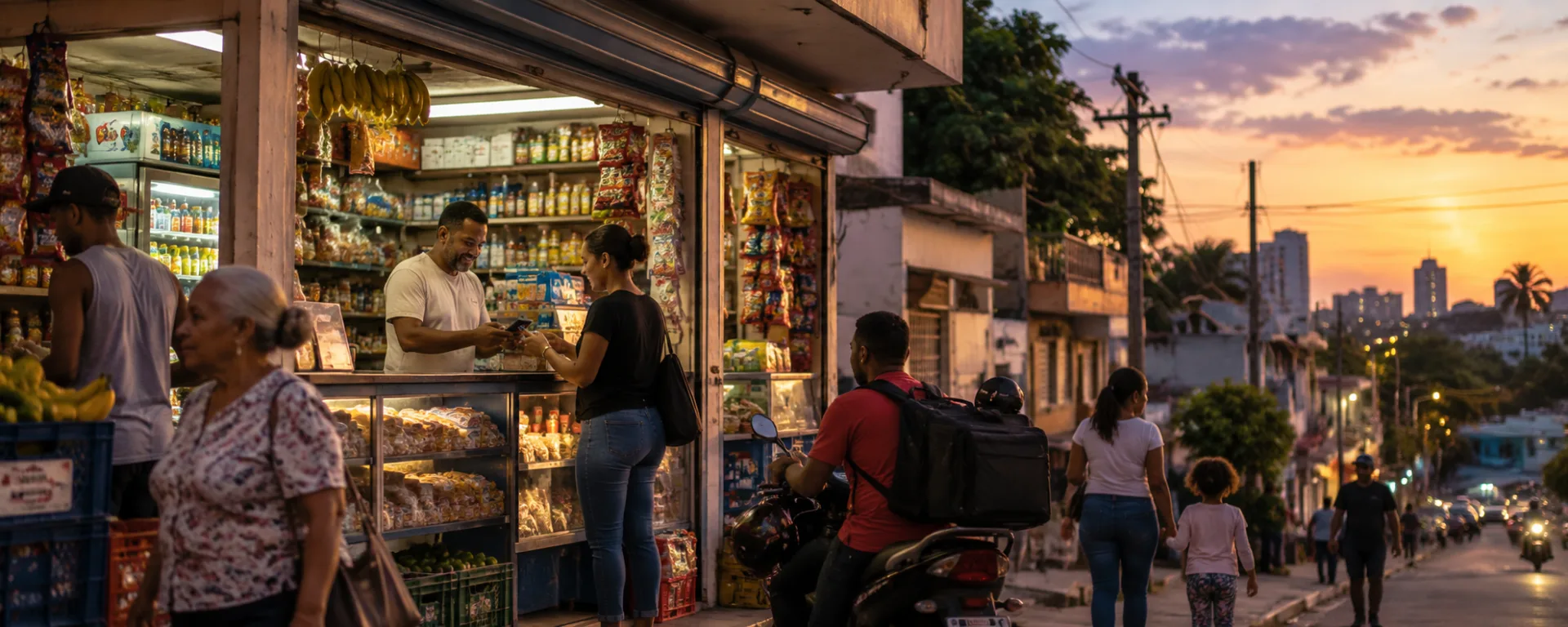
We call it the colmado.

01

The bank branch and the colmado optimize for different things

A bank branch is specialized.

That specialization creates enormous value.

Professional employees. Security. Compliance. Complex products. Controlled processes.

But specialization is expensive.

Every branch needs enough financial activity to justify the location.

The colmado exists for an entirely different purpose.

People already go there.

For rice. Water. Bread. Coffee. Soap.

Something missing from dinner.

Something at 9:30 p.m.

Sometimes something on credit.

Its primary advantage is not financial sophistication.

It is proximity to everyday life.

That may be exactly what financial inclusion needs.

02

Financial inclusion is not just an account-ownership problem

We often measure financial inclusion by asking whether someone has access to an account.

That is useful.

But it can hide friction.

A person may technically have access to withdrawal services.

If reaching those services requires transportation, waiting and rearranging part of the day, the service exists but remains inconvenient.

A RD$500 transaction can become irrational if accessing it costs RD$150 and an hour of time.

Move that same service three minutes away and the economics change.

Small transactions become practical.

Repeated transactions become habits.

The service becomes ordinary.

And true inclusion often begins when finance becomes ordinary rather than exceptional.

03

The Dominican financial system already understands this

The Superintendencia de Bancos currently lists more than 7,000 banking subagents throughout the country.

These are commercial businesses or individuals authorized through participating financial institutions to perform designated financial services.

That is not a theoretical model.

It is already part of Dominican financial infrastructure.

And it tells us something profound:

The industry has already concluded that a financial service does not always require a dedicated financial building.

04

Existing businesses change the economics of distribution

A new bank branch requires real estate, dedicated employees, utilities, security, technology and operating overhead.

An agent location already has many of those things because another business pays for them.

That means the same rent, counter, electricity and staff member can support more than one commercial function.

This is why agent banking has become so important across emerging markets.

CGAP's research on last-mile networks highlights the value of using existing local retailers and improving agent economics through multiple services and revenue streams.

That is not simply financial inclusion policy.

It is distribution economics.

05

Frequency may matter as much as proximity

How often does the average consumer visit a bank branch?

Now compare that with visits to neighborhood stores.

Frequency matters because behavior forms through repetition.

A financial application used once every three months remains unfamiliar.

A digital payment used three times a week becomes normal.

This connects directly to the merchant-acceptance problem described by the World Bank.

Digital accounts can exist while digital commerce remains weak because consumers still have too few everyday places to use them. The World Bank calls small merchants a critical bottleneck between digital access and actual digital-payment use.

Now invert the problem.

The merchant that was the bottleneck can become the distribution point.

06

Trust has physical geography

There is another asset the colmado does not list on its balance sheet.

Familiarity.

The merchant knows customers.

Customers know where the store is.

The business is visible.

If something goes wrong, the location will probably still be there tomorrow.

That physical permanence matters.

Technology companies spend heavily trying to manufacture trust through interfaces, branding, ratings, customer support and guarantees.

A neighborhood merchant begins with something digital products cannot instantly replicate:

social presence.

That does not eliminate the need for compliance.

It does not replace financial regulation.

It does not mean merchants should perform activities for which they are not authorized.

It simply means regulated infrastructure can be delivered through places that already possess community familiarity.

07

A colmado does not have to become a bank

That distinction is essential.

The opportunity is not for every retailer to start underwriting loans or safeguarding money independently.

The intelligence can remain behind the scenes.

Identity checks. Transaction monitoring. Recordkeeping. Limits. Compliance. Settlement. Fraud controls.

The regulated platform performs those functions.

The local business provides accessibility.

The merchant becomes the interface, not the financial institution.
08

The small business can become both merchant and infrastructure

This is where the idea becomes more interesting.

Historically, we put companies into boxes.

A colmado is a merchant.

A bank branch is financial infrastructure.

A telecom tower is communications infrastructure.

Digital platforms blur those lines.

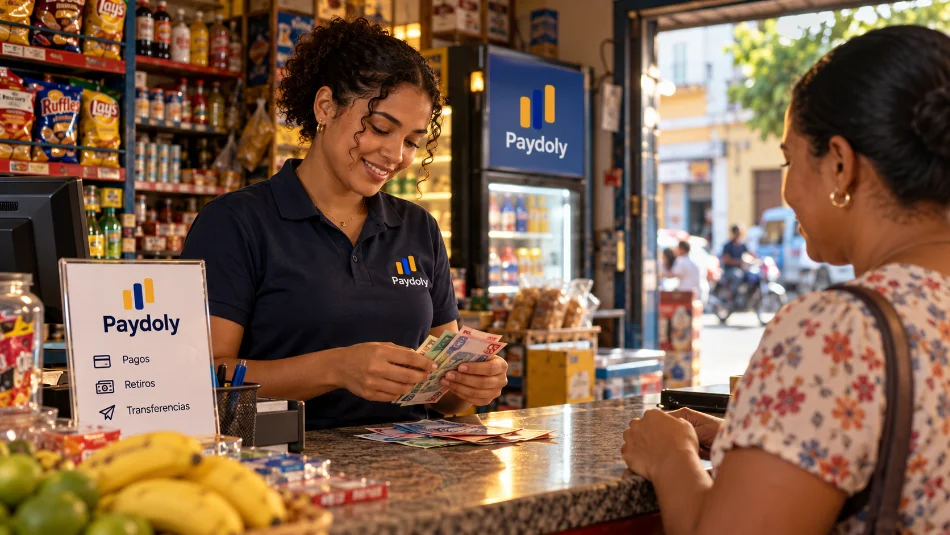
A neighborhood business can remain a retailer while also becoming a cash-in point, a cash-out point, a payment-acceptance location, an onboarding touchpoint, a place for customer assistance and an entry point into the digital economy.

The store is still a store.

But financially, it becomes a node.

That is a very different way of imagining infrastructure.

09

Financial inclusion can become a two-way street

The National MSME Survey estimated that Dominican MSMEs generate roughly 61.6% of employment.

So consider what happens when thousands of these businesses become financially connected.

The network brings financial access into neighborhoods.

But the same network can also bring the merchant deeper into formal financial activity.

Digital transaction records. Documented commissions. Business balances. Customer activity. More structured cash flow. Potentially greater visibility to lenders.

The merchant helps distribute financial services.

Financial infrastructure makes the merchant more legible.

Both sides move toward each other.

10

The future may look surprisingly ordinary

Technology tends to depict the future with obvious visual signals.

Glass towers. Screens everywhere. No cash. No humans.

But some of the most transformational financial technology in the Dominican Republic may look almost identical from the street.

Same colmado.

Same shelves.

Same owner.

Same neighbors walking in.

The difference is underneath.

The store is connected to a digital financial network.

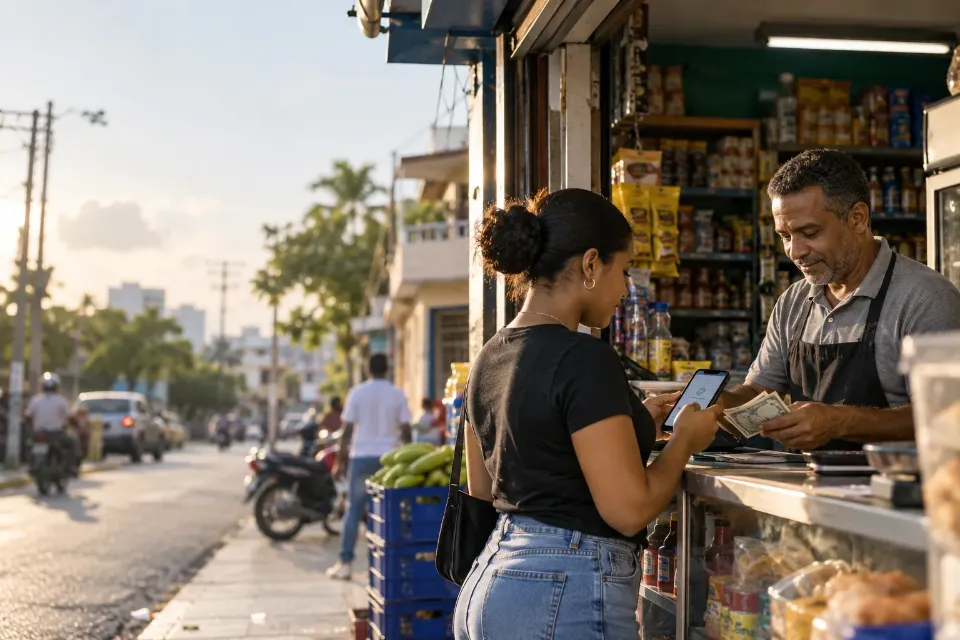
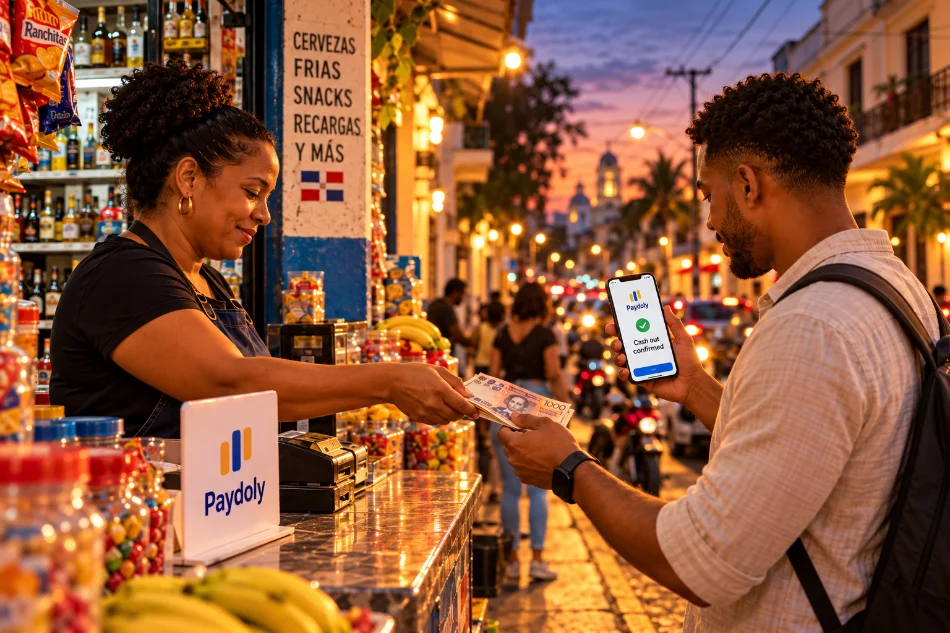
A customer can move between cash and digital money.

The merchant can receive electronic payments.

Financial services reach a neighborhood without constructing a branch there.

Nothing looks futuristic.

Everything underneath it is.

The next great financial-distribution network may not be built by opening thousands of new locations. It may be built by connecting thousands of locations people already use.
Built for how you actually use your money.

Paydoly is building infrastructure that brings digital finance closer to where everyday economic life already happens.

Up next

The real cost of cash for Dominican small businesses

Cash looks free. But once you count the time spent handling it, trips to the bank, change on hand, shrinkage and lost sales, it can become one of the most expensive ways for a small business to get paid.

Business · 5 min read
Blog

More from Paydoly Insights

All articles
Insights
Agents

The last mile of digital finance is still physical

Digital finance sounds virtual. In cash-heavy economies, its usefulness often depends on something very physical: a person, a counter and somewhere nearby where money can cross between cash and digital form.

7 min read
Insights
Business

The informal economy is already digital. It just doesn’t have the infrastructure yet.

The biggest misconception about the informal economy is that it is offline. It isn’t. Across the Dominican Republic, discovery, selling, ordering and customer service are already happening on phones. What is still catching up is the financial infrastructure underneath them.

7 min read
Insights
Agents

Why agent networks are the bridge between cash and digital

Digital payments only work in a cash economy if cash can get in and out easily. That is the job of the neighbourhood agent.

5 min read
Paydoly

A financial network for the way money really moves — people, businesses and local cash agents on one balance, in pesos and dollars.

Paydoly entities
Paydoly Inc.Parent company · United States · Registered Money Services Business (MSB)
Paydoly Dominicana, S.R.L.Operating company · Santo Domingo, Dominican Republic · EPE license with the SIB in progress
Important information

Corporate structure. Paydoly Inc. is the parent company of the Paydoly group and oversees the Paydoly brand, technology platform, intellectual property, and broader group operations. Paydoly Dominicana, S.R.L. is the Dominican Republic operating entity through which applicable Paydoly products and services are made available to consumers, merchants, agents, and business customers in that market. References on this website to “Paydoly,” “we,” “our,” or “us” refer collectively to Paydoly Inc. and its applicable subsidiaries or affiliates, unless a specific entity is identified.

Financial services; not a bank. Paydoly is a financial technology and payments company and is not a bank. Paydoly does not accept deposits as a banking institution and does not pay interest on customer payment-account balances unless expressly stated otherwise for a specific product. Certain regulated financial services may be provided by Paydoly entities, licensed financial institutions, payment-service providers, or other authorized financial partners, depending on the product and jurisdiction. Customer funds are held, safeguarded, segregated, or otherwise maintained in accordance with the legal and regulatory requirements applicable to the relevant service. Any deposit-insurance protection applies only where expressly provided through an eligible financial institution and applicable law and should not be assumed solely because funds are accessible through Paydoly.

Regulatory status and availability. Paydoly products and services are offered only where legally permitted and may be subject to regulatory authorization, geographic availability, identity and business verification, eligibility criteria, transaction limits, compliance review, and approval. Certain products or features described on this website may be in development, private beta, pilot, limited release, or not yet commercially available. Availability may differ by country, customer type, account type, currency, payment method, or Financial Services Provider. Nothing on this website constitutes an offer, solicitation, recommendation, or commitment to provide a regulated financial product or service in any jurisdiction where doing so would be unlawful or where the applicable service has not been made available.

Product information and pricing. Product descriptions, features, limits, processing times, and pricing presented on this website are provided for general informational purposes and may change as Paydoly develops its products, commercial terms, and regulatory framework. Unless expressly identified as final and binding, published pricing does not constitute a contractual offer or guarantee. Applicable fees, foreign-exchange rates, charges, limits, and other material transaction terms will be disclosed through the Paydoly application, website, applicable service agreement, or transaction interface before you authorize the relevant service or transaction.

Illustrative content. Names, balances, transaction amounts, businesses, merchant profiles, agents, locations, user interfaces, screenshots, charts, payment activity, and other examples displayed on this website may be simulated, anonymized, or illustrative. They should not be interpreted as representations of actual customers, accounts, transactions, performance, balances, or financial outcomes unless expressly identified otherwise. References to alternative payment methods, industry practices, costs, or user experiences are provided for general informational purposes and may not reflect every provider, customer, transaction, or market.

Forward-looking information. This website may contain statements regarding future products, functionality, market expansion, partnerships, regulatory developments, business strategy, adoption, growth, expected performance, or other anticipated developments. These statements reflect current plans and expectations, are inherently subject to risks, assumptions, dependencies, and uncertainties, and should not be interpreted as guarantees of future performance or availability. Actual results, timelines, functionality, and market availability may differ materially. Except where required by applicable law, Paydoly undertakes no obligation to publicly update forward-looking statements.

Third-party services. Certain Paydoly services may depend on or integrate with banks, payment networks, processors, identity-verification providers, technology providers, telecommunications providers, merchants, agents, or other third parties. References to third-party products, services, trademarks, or companies do not imply ownership, sponsorship, endorsement, or affiliation except where expressly stated. Third-party services may be governed by separate terms, conditions, availability requirements, and privacy practices.

No financial, legal, tax, or investment advice. Information provided through this website is for general informational purposes only and does not constitute financial, investment, legal, accounting, tax, or other professional advice. You should obtain independent professional advice where appropriate to your circumstances.

Intellectual property. Paydoly®, the Paydoly name, Paydoly logos, product names, designs, software, interfaces, and related brand elements are trademarks or other intellectual property of Paydoly Inc. or its applicable affiliates. All other trademarks, product names, logos, and company names are the property of their respective owners. Nothing on this website grants any license or right to use Paydoly intellectual property except as expressly authorized in writing.

Legal terms and privacy. Access to and use of Paydoly websites, applications, products, and services are subject to the applicable Paydoly Services Agreement, product-specific terms, Privacy Policy, Cookie & Tracking Technologies Policy, Acceptable Use Policy, Electronic Communications Consent, Complaints & Error Resolution Policy, Regional Terms, and any other terms or disclosures applicable to the relevant service.

Changes to information. Paydoly may update this website, its products, disclosures, policies, pricing, or legal terms from time to time. The most current version of applicable legal terms and policies will be published through the Paydoly Legal Center or otherwise made available through the relevant Paydoly service.

© 2026 Paydoly Inc. All rights reserved.