Paydoly
Get started

The last mile of digital finance is still physical

Digital finance sounds virtual. In cash-heavy economies, its usefulness often depends on something very physical: a person, a counter and somewhere nearby where money can cross between cash and digital form.

Paydoly Insights7 min read

There is a strange paradox at the center of digital finance.

We talk about wallets, instant payments and cashless commerce as though the future of money will exist entirely on screens.

Then someone receives RD$10,000 digitally and needs RD$3,000 in physical cash.

Suddenly geography matters again.

Where is the nearest ATM?

Is it working?

How much will it charge?

Is there a bank nearby?

Can the user get there before it closes?

This is the part of digital finance that product demos rarely show.

Digital money still has to meet the physical economy.

And in a cash-heavy market, the quality of that meeting can determine whether digital finance becomes useful at all.

01

A wallet is not the last mile

Downloading an application is easy.

Living entirely inside it is not.

The rent may be paid in cash.

A supplier may need pesos.

A customer may walk into a business carrying physical money.

A family member may hand someone RD$2,000 and ask them to send it digitally.

A merchant may receive QR payments but still need cash in the drawer tomorrow morning.

For these users, conversion between cash and digital value is not an edge case.

It is part of the financial system.

CGAP describes this need as allowing users to “switch between the worlds of cash and digital currency.” Its research identifies cash-in/cash-out networks as a foundational component of digital financial inclusion in cash-based societies.

That produces a counterintuitive insight:

The opposite of cash is not digital money. The opposite of cash is being trapped in cash.

A useful financial system allows value to move both ways.

02

Cashing out does not necessarily mean digitization failed

At first, withdrawal seems like the opposite of digital adoption.

Why build a wallet only for people to take the money back out?

Because convertibility creates confidence.

Imagine telling a new user:

“Put your money into this wallet. It works where accepted, but getting your cash back will be difficult.”

That sounds less like financial inclusion and more like a trap.

Reliable access to cash changes the psychology.

The user knows the balance remains useful outside the digital network.

Paradoxically, a good exit can make people more willing to enter.

03

The world has already learned this lesson at massive scale

Mobile money provides one of the clearest examples.

GSMA reports that mobile-money services processed more than $2 trillion globally in 2025, with 593 million active 30-day accounts.

Merchant payments reached approximately $155 billion, growing by almost half in one year.

Those numbers describe one of the world's largest digital-finance ecosystems.

And yet agent networks remain fundamental in many of the markets where mobile money became transformative.

Why?

Because the economy surrounding the wallet is still partly physical.

Software can move value instantly.

Access still has a location.

04

The Dominican Republic already uses this architecture

Agent-based finance is not a foreign concept in the Dominican Republic.

The Superintendencia de Bancos' current directory lists approximately 7,187 banking subagents, in addition to nearly 300 exchange subagents.

The regulator defines these as commercial individuals or businesses contracted by financial institutions to conduct permitted services on their behalf.

That is an important clue.

The market has already recognized that the bank branch cannot be the only interface between the financial system and daily life.

A branch is specialized infrastructure.

A neighborhood business already has rent, staff, a counter, opening hours, customers and a location people know.

Agent networks layer financial access onto commercial infrastructure that already exists.

05

Perhaps the last-mile network has already been built

If you wanted thousands of physical access points across a country, constructing them from scratch would be extraordinarily expensive.

But what if the locations already existed?

Colmados. Pharmacies. Phone stores. Mini-markets. Service centers. Other neighborhood businesses.

The problem is no longer real estate.

It becomes coordination.

Who can become an agent?

What services can they perform?

How is identity verified?

How is fraud monitored?

How is liquidity managed?

How is the customer protected?

The physical network may already be there.

The financial operating system is what needs to be connected to it.

06

The invisible product is liquidity

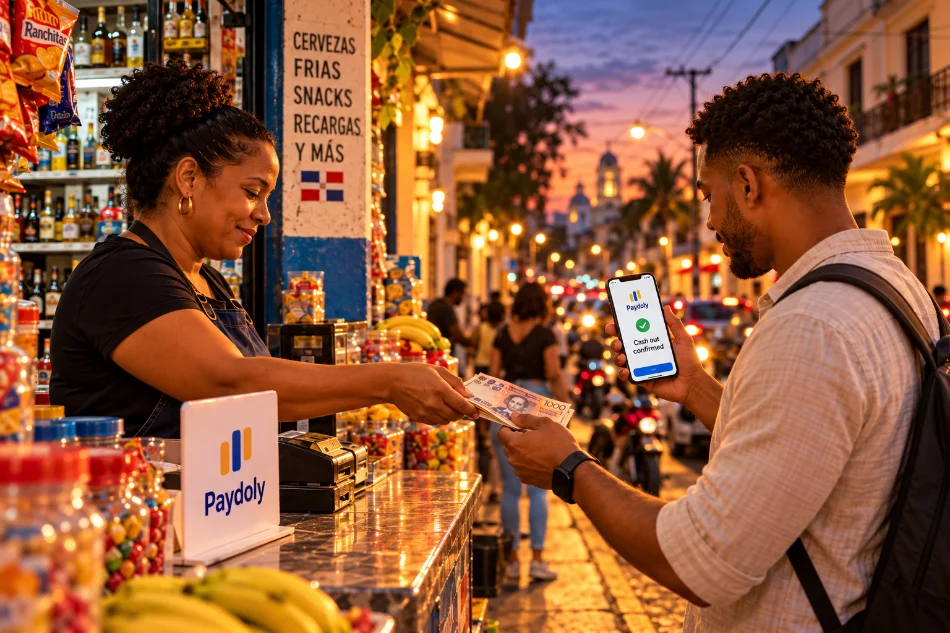
An agent can display a sign saying “Cash Out Here.”

That sign means nothing if the agent has no cash.

Likewise, cash-in fails if the agent lacks sufficient electronic float.

So an agent is actually managing two inventories:

physical liquidity and digital liquidity.

That makes agent networks partly a treasury-management problem.

If one neighborhood mostly withdraws, the network must replenish physical cash.

If another mostly deposits, digital float must be replenished.

Customer experience depends on a balancing problem the customer never sees.

This is why a great agent network is not simply a large list of locations.

It is a liquidity network.

07

Digital adoption can initially make physical access more important

This is another counterintuitive idea.

You might expect cash-in/cash-out demand to fall immediately as digital finance grows.

Eventually, perhaps.

But during the transition, the opposite can happen.

Someone who receives one digital transfer per month may rarely need an agent.

Someone who begins receiving salary, merchant revenue, remittances and family transfers digitally now has much more value flowing through the system.

If the surrounding economy remains partly cash-based, more digital inflows can temporarily create more need for physical conversion.

The road toward less cash can therefore pass through better cash access first.

That is also why “Remittances arrive in dollars. Life is paid in pesos.” is ultimately a last-mile story.

Money may cross an ocean electronically.

The recipient still has to use it on the street where they live.

08

Agents can do something ATMs cannot

An ATM can execute instructions.

An agent can provide context.

A first-time user may need help.

Someone may not understand a failed transaction.

A customer may trust a merchant they have known for five years more than a new financial application they downloaded yesterday.

This human layer is easy to dismiss as temporary.

It may actually be essential during adoption.

Technology reduces the cost of finance.

People can reduce the psychological distance to it.

09

Digital at the center. Local at the edge.

The future does not necessarily mean fewer local financial touchpoints.

It can mean a centralized digital platform connecting to thousands of distributed physical locations.

The phone handles information.

The network handles settlement.

The local agent handles physical access.

Each layer does what it does best.

The last mile of digital finance is not something to build after the digital system is complete. In a cash-heavy economy, it may be the infrastructure that makes the digital system usable in the first place.
Built for how you actually use your money.

Paydoly is building financial infrastructure that understands a simple reality: sometimes cash needs to become digital, and sometimes digital money needs to become cash.

Up next

Why the colmado may be more important to financial inclusion than the bank branch

A bank branch is designed to provide financial services. A colmado is designed to serve a neighborhood. For the next phase of financial inclusion, that difference may matter more than it seems.

Agents · 6 min read
Blog

More from Paydoly Insights

All articles
Blog
Money

Remittances arrive in dollars. Life is paid in pesos.

Families across the Dominican Republic live between two currencies. The tools they use to receive, hold and convert money should reflect that.

5 min read
Insights
Agents

Why agent networks are the bridge between cash and digital

Digital payments only work in a cash economy if cash can get in and out easily. That is the job of the neighbourhood agent.

5 min read
Insights
Business

The informal economy is already digital. It just doesn’t have the infrastructure yet.

The biggest misconception about the informal economy is that it is offline. It isn’t. Across the Dominican Republic, discovery, selling, ordering and customer service are already happening on phones. What is still catching up is the financial infrastructure underneath them.

7 min read
Paydoly

A financial network for the way money really moves — people, businesses and local cash agents on one balance, in pesos and dollars.

Paydoly entities
Paydoly Inc.Parent company · United States · Registered Money Services Business (MSB)
Paydoly Dominicana, S.R.L.Operating company · Santo Domingo, Dominican Republic · EPE license with the SIB in progress
Important information

Corporate structure. Paydoly Inc. is the parent company of the Paydoly group and oversees the Paydoly brand, technology platform, intellectual property, and broader group operations. Paydoly Dominicana, S.R.L. is the Dominican Republic operating entity through which applicable Paydoly products and services are made available to consumers, merchants, agents, and business customers in that market. References on this website to “Paydoly,” “we,” “our,” or “us” refer collectively to Paydoly Inc. and its applicable subsidiaries or affiliates, unless a specific entity is identified.

Financial services; not a bank. Paydoly is a financial technology and payments company and is not a bank. Paydoly does not accept deposits as a banking institution and does not pay interest on customer payment-account balances unless expressly stated otherwise for a specific product. Certain regulated financial services may be provided by Paydoly entities, licensed financial institutions, payment-service providers, or other authorized financial partners, depending on the product and jurisdiction. Customer funds are held, safeguarded, segregated, or otherwise maintained in accordance with the legal and regulatory requirements applicable to the relevant service. Any deposit-insurance protection applies only where expressly provided through an eligible financial institution and applicable law and should not be assumed solely because funds are accessible through Paydoly.

Regulatory status and availability. Paydoly products and services are offered only where legally permitted and may be subject to regulatory authorization, geographic availability, identity and business verification, eligibility criteria, transaction limits, compliance review, and approval. Certain products or features described on this website may be in development, private beta, pilot, limited release, or not yet commercially available. Availability may differ by country, customer type, account type, currency, payment method, or Financial Services Provider. Nothing on this website constitutes an offer, solicitation, recommendation, or commitment to provide a regulated financial product or service in any jurisdiction where doing so would be unlawful or where the applicable service has not been made available.

Product information and pricing. Product descriptions, features, limits, processing times, and pricing presented on this website are provided for general informational purposes and may change as Paydoly develops its products, commercial terms, and regulatory framework. Unless expressly identified as final and binding, published pricing does not constitute a contractual offer or guarantee. Applicable fees, foreign-exchange rates, charges, limits, and other material transaction terms will be disclosed through the Paydoly application, website, applicable service agreement, or transaction interface before you authorize the relevant service or transaction.

Illustrative content. Names, balances, transaction amounts, businesses, merchant profiles, agents, locations, user interfaces, screenshots, charts, payment activity, and other examples displayed on this website may be simulated, anonymized, or illustrative. They should not be interpreted as representations of actual customers, accounts, transactions, performance, balances, or financial outcomes unless expressly identified otherwise. References to alternative payment methods, industry practices, costs, or user experiences are provided for general informational purposes and may not reflect every provider, customer, transaction, or market.

Forward-looking information. This website may contain statements regarding future products, functionality, market expansion, partnerships, regulatory developments, business strategy, adoption, growth, expected performance, or other anticipated developments. These statements reflect current plans and expectations, are inherently subject to risks, assumptions, dependencies, and uncertainties, and should not be interpreted as guarantees of future performance or availability. Actual results, timelines, functionality, and market availability may differ materially. Except where required by applicable law, Paydoly undertakes no obligation to publicly update forward-looking statements.

Third-party services. Certain Paydoly services may depend on or integrate with banks, payment networks, processors, identity-verification providers, technology providers, telecommunications providers, merchants, agents, or other third parties. References to third-party products, services, trademarks, or companies do not imply ownership, sponsorship, endorsement, or affiliation except where expressly stated. Third-party services may be governed by separate terms, conditions, availability requirements, and privacy practices.

No financial, legal, tax, or investment advice. Information provided through this website is for general informational purposes only and does not constitute financial, investment, legal, accounting, tax, or other professional advice. You should obtain independent professional advice where appropriate to your circumstances.

Intellectual property. Paydoly®, the Paydoly name, Paydoly logos, product names, designs, software, interfaces, and related brand elements are trademarks or other intellectual property of Paydoly Inc. or its applicable affiliates. All other trademarks, product names, logos, and company names are the property of their respective owners. Nothing on this website grants any license or right to use Paydoly intellectual property except as expressly authorized in writing.

Legal terms and privacy. Access to and use of Paydoly websites, applications, products, and services are subject to the applicable Paydoly Services Agreement, product-specific terms, Privacy Policy, Cookie & Tracking Technologies Policy, Acceptable Use Policy, Electronic Communications Consent, Complaints & Error Resolution Policy, Regional Terms, and any other terms or disclosures applicable to the relevant service.

Changes to information. Paydoly may update this website, its products, disclosures, policies, pricing, or legal terms from time to time. The most current version of applicable legal terms and policies will be published through the Paydoly Legal Center or otherwise made available through the relevant Paydoly service.

© 2026 Paydoly Inc. All rights reserved.