Paydoly
Get started

QR payments and the markets that leapfrogged cards

Brazil, India and other fast-digitizing economies did not wait for cards to become the only way to move beyond cash. They built simpler account-to-account payment systems around the mobile phone. The Dominican Republic can learn from that.

Paydoly Insights8 min read

For years, the path from cash to digital payments seemed obvious.

First came bank accounts. Then debit and credit cards. Then card terminals at merchants. Eventually, mobile payments were layered on top.

But some of the world's largest emerging economies followed a different path.

Instead of making every small merchant depend on traditional card infrastructure, they made it possible for people to send money directly from one account to another, often using nothing more than a phone and a QR code.

Brazil has Pix.

India has UPI.

Both demonstrate something important: a country does not necessarily need to reproduce decades of card-based payment infrastructure before everyday commerce can become digital.

01

Brazil changed how people think about payments

Brazil launched Pix in 2020 as an instant-payment system operated within the country's financial infrastructure.

It allows money to move between participating accounts within seconds, 24 hours a day, including weekends and holidays. QR codes can be used to initiate payments at businesses, alongside other identifiers and payment methods.

The important part is not simply that Pix is fast.

It is that paying a merchant does not necessarily require the traditional card model.

A customer can initiate a payment from a bank or payment account, and the merchant receives the funds directly through the instant-payment network.

For a small business, that changes the economics and infrastructure required to accept digital payments.

Instead of asking, "How do we give every merchant a card terminal?" the question becomes, "How easily can every merchant receive a digital payment?"

Those are very different problems.

02

India followed a similar principle

India's Unified Payments Interface, or UPI, made interoperable bank-to-bank payments available through mobile applications.

QR codes became an important part of that experience.

A customer can scan a merchant's QR code, approve the payment through a compatible application and transfer money directly from their account. UPI QR payments have since expanded beyond domestic commerce into international merchant acceptance as well.

The result is something immediately recognizable in Indian cities and neighborhoods: QR codes displayed by businesses ranging from established retailers to very small merchants.

The technology required at the point of sale can be remarkably simple.

The intelligence sits in the payment network and the customer's phone.

03

The lesson is not that cards failed

Cards remain enormously important in both countries.

The lesson is more subtle.

Digital payments do not have to mean replacing cash exclusively with plastic.

Cards were developed for an earlier generation of commerce, when consumers needed a physical credential and merchants needed dedicated hardware to communicate with financial networks.

Smartphones change that equation.

The customer already carries a connected device.

The merchant often has one too.

A QR code can become the bridge between them.

That makes account-to-account payments particularly interesting for countries where cash remains widespread and millions of smaller merchants have never built their businesses around sophisticated card infrastructure.

04

Why this matters for the Dominican Republic

The Dominican Republic is not starting from zero.

The country already has electronic banking, cards, mobile payments and infrastructure for real-time financial settlement. Banco Central has also developed its Pagos al Instante service, which allows participating banking customers to make transfers and payments with near-immediate crediting.

But everyday merchant commerce is still heavily influenced by cash.

That creates an interesting opportunity.

The question does not have to be whether every colmado, barbería, salon, cafeteria or independent professional will eventually operate a traditional card terminal.

The better question may be whether every one of those businesses can have a simple way to receive digital money.

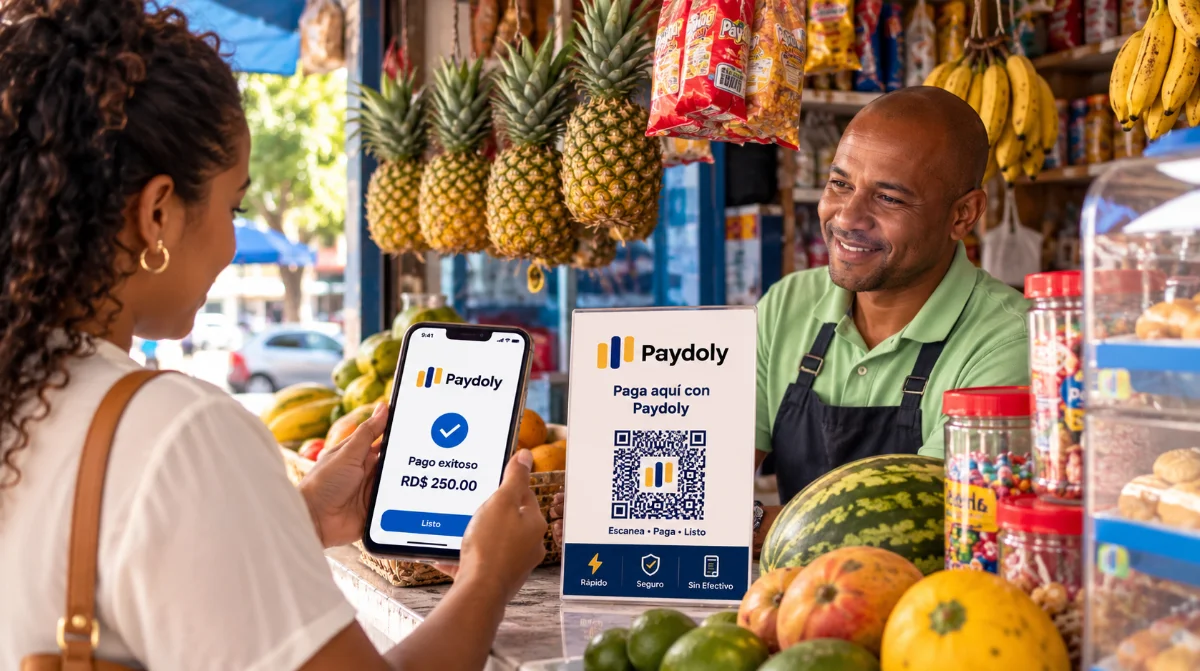
A printed QR code requires almost no counter space.

A customer does not need to hand over cash.

The merchant does not need to make change.

And the transaction can create a digital record immediately.

For small businesses, simplicity matters.

05

QR changes the point of sale

Traditional payment infrastructure puts much of the technology on the merchant side.

There is a terminal.

The terminal needs connectivity.

The merchant has to acquire or receive the hardware.

The payment travels through multiple parties before settlement.

QR payments can shift more of the interaction to software.

The merchant displays a code.

The customer scans it.

The customer's application handles the payment.

That does not mean there is no infrastructure behind the transaction. There is a great deal of infrastructure behind it.

The difference is that the complexity does not have to sit on the merchant's counter.

The most important payment technology may be the one the merchant barely has to think about.
06

This matters most at the smallest businesses

A large supermarket can support multiple payment systems, terminals and checkout lanes.

A neighborhood merchant operates differently.

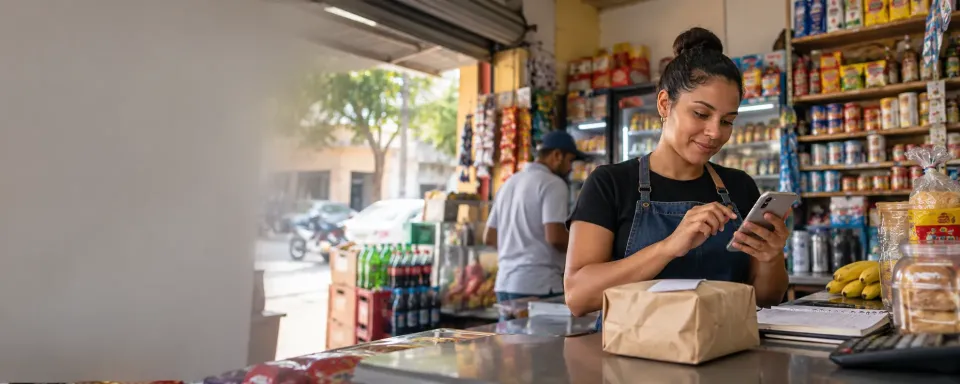
A colmado may have one counter.

A barber may collect payments between appointments.

A street-level business may not want additional hardware, contracts and operational complexity just to accept a digital payment.

For these businesses, the barrier to digital payments is not simply whether the technology exists.

It is whether the technology fits naturally into how they already work.

A QR code can.

That is one of the reasons QR-based account payments became so powerful in markets with enormous numbers of small merchants.

07

The real opportunity is interoperability

QR codes by themselves are not revolutionary.

Anyone can generate a square image with information inside it.

What makes systems such as Pix and UPI powerful is what sits behind the QR code: financial accounts, interoperable payment rails, real-time settlement and broad participation.

A successful payment ecosystem cannot become a collection of isolated QR codes where one application only works with one merchant network.

The more easily customers and businesses can move money across institutions and use cases, the more valuable the network becomes.

For the Dominican Republic, this is an important distinction.

The goal should not simply be to make payments digital.

It should be to make them useful, accessible and connected.

08

Cash and QR can coexist

Brazil and India also offer another useful lesson: digital payment adoption does not require cash to disappear first.

Consumers can adopt a new payment method because it is convenient while continuing to use cash in other situations.

That is particularly relevant for the Dominican Republic.

A merchant does not need to wake up one morning and become "cashless."

They can simply add another way to get paid.

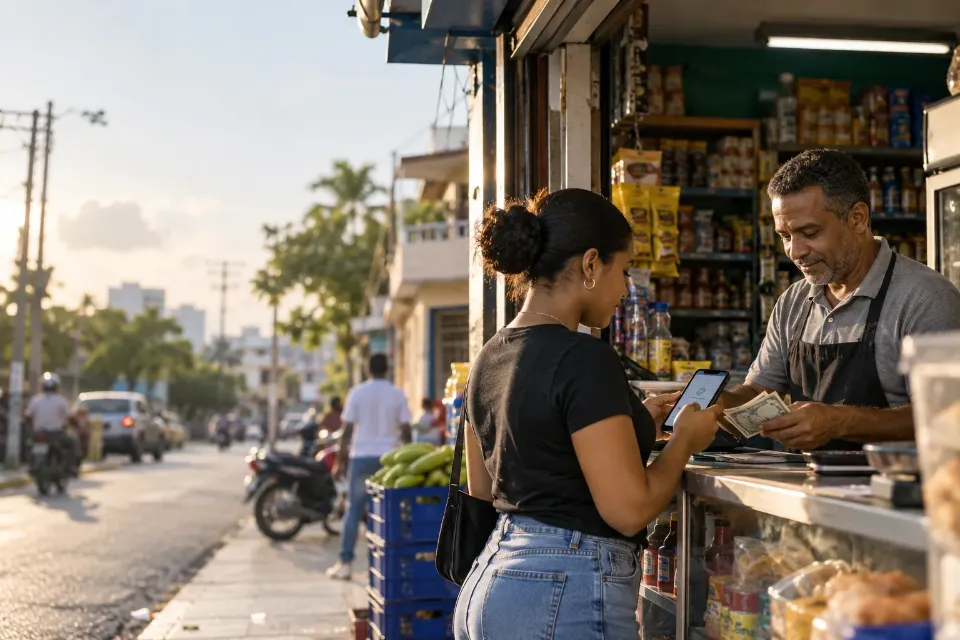
One customer hands over pesos.

The next scans a QR code.

Another sends money remotely.

Over time, the percentage of transactions happening digitally can increase without requiring merchants or consumers to make an all-or-nothing decision.

09

The Dominican Republic can take its own path

The goal should not be to copy Brazil or India exactly.

Their banking systems, populations, regulations and economic structures are different.

But the principle is transferable.

Countries do not have to follow the same payment evolution as the United States or Europe.

A market with high smartphone usage, large numbers of small merchants and continued dependence on cash may be particularly well suited to a model where mobile payments, QR codes and account-to-account transfers develop alongside cards.

That could mean a Dominican payment landscape where cards remain important, cash remains available, but neither is the only practical way to pay.

10

From cash directly to digital

For many Dominican businesses, the next stage of payment modernization may not be:

01Cash02card terminal03digital wallet

It could simply be:

01Cash02phone

That is the larger lesson from markets such as Brazil and India.

The biggest change was not the QR code itself.

It was making digital payments simple enough that millions of ordinary people and small businesses could use them as part of everyday commerce.

The Dominican Republic has an opportunity to build around the same principle while designing for its own economy.

The future of payments does not have to look like the past with newer hardware. Sometimes an economy can skip a step entirely.
Built for how you actually use your money.

Paydoly is building payment infrastructure designed for the way people and businesses move between cash and digital money.

Up next

Escrow for everyday commerce: trust in social-media selling

Much of today’s commerce starts in a chat. Escrow gives both sides a reason to say yes to someone they’ve never met.

Payments · 7 min read
Blog

More from Paydoly Insights

All articles
Insights
Business

The informal economy is already digital. It just doesn’t have the infrastructure yet.

The biggest misconception about the informal economy is that it is offline. It isn’t. Across the Dominican Republic, discovery, selling, ordering and customer service are already happening on phones. What is still catching up is the financial infrastructure underneath them.

7 min read
Insights
Business

Why small businesses don’t need more payment options. They need fewer payment problems.

Fintech has spent years adding ways to pay. Small merchants are asking a much simpler question: does any of this make running the business easier?

7 min read
Insights
Agents

The last mile of digital finance is still physical

Digital finance sounds virtual. In cash-heavy economies, its usefulness often depends on something very physical: a person, a counter and somewhere nearby where money can cross between cash and digital form.

7 min read
Paydoly

A financial network for the way money really moves — people, businesses and local cash agents on one balance, in pesos and dollars.

Paydoly entities
Paydoly Inc.Parent company · United States · Registered Money Services Business (MSB)
Paydoly Dominicana, S.R.L.Operating company · Santo Domingo, Dominican Republic · EPE license with the SIB in progress
Important information

Corporate structure. Paydoly Inc. is the parent company of the Paydoly group and oversees the Paydoly brand, technology platform, intellectual property, and broader group operations. Paydoly Dominicana, S.R.L. is the Dominican Republic operating entity through which applicable Paydoly products and services are made available to consumers, merchants, agents, and business customers in that market. References on this website to “Paydoly,” “we,” “our,” or “us” refer collectively to Paydoly Inc. and its applicable subsidiaries or affiliates, unless a specific entity is identified.

Financial services; not a bank. Paydoly is a financial technology and payments company and is not a bank. Paydoly does not accept deposits as a banking institution and does not pay interest on customer payment-account balances unless expressly stated otherwise for a specific product. Certain regulated financial services may be provided by Paydoly entities, licensed financial institutions, payment-service providers, or other authorized financial partners, depending on the product and jurisdiction. Customer funds are held, safeguarded, segregated, or otherwise maintained in accordance with the legal and regulatory requirements applicable to the relevant service. Any deposit-insurance protection applies only where expressly provided through an eligible financial institution and applicable law and should not be assumed solely because funds are accessible through Paydoly.

Regulatory status and availability. Paydoly products and services are offered only where legally permitted and may be subject to regulatory authorization, geographic availability, identity and business verification, eligibility criteria, transaction limits, compliance review, and approval. Certain products or features described on this website may be in development, private beta, pilot, limited release, or not yet commercially available. Availability may differ by country, customer type, account type, currency, payment method, or Financial Services Provider. Nothing on this website constitutes an offer, solicitation, recommendation, or commitment to provide a regulated financial product or service in any jurisdiction where doing so would be unlawful or where the applicable service has not been made available.

Product information and pricing. Product descriptions, features, limits, processing times, and pricing presented on this website are provided for general informational purposes and may change as Paydoly develops its products, commercial terms, and regulatory framework. Unless expressly identified as final and binding, published pricing does not constitute a contractual offer or guarantee. Applicable fees, foreign-exchange rates, charges, limits, and other material transaction terms will be disclosed through the Paydoly application, website, applicable service agreement, or transaction interface before you authorize the relevant service or transaction.

Illustrative content. Names, balances, transaction amounts, businesses, merchant profiles, agents, locations, user interfaces, screenshots, charts, payment activity, and other examples displayed on this website may be simulated, anonymized, or illustrative. They should not be interpreted as representations of actual customers, accounts, transactions, performance, balances, or financial outcomes unless expressly identified otherwise. References to alternative payment methods, industry practices, costs, or user experiences are provided for general informational purposes and may not reflect every provider, customer, transaction, or market.

Forward-looking information. This website may contain statements regarding future products, functionality, market expansion, partnerships, regulatory developments, business strategy, adoption, growth, expected performance, or other anticipated developments. These statements reflect current plans and expectations, are inherently subject to risks, assumptions, dependencies, and uncertainties, and should not be interpreted as guarantees of future performance or availability. Actual results, timelines, functionality, and market availability may differ materially. Except where required by applicable law, Paydoly undertakes no obligation to publicly update forward-looking statements.

Third-party services. Certain Paydoly services may depend on or integrate with banks, payment networks, processors, identity-verification providers, technology providers, telecommunications providers, merchants, agents, or other third parties. References to third-party products, services, trademarks, or companies do not imply ownership, sponsorship, endorsement, or affiliation except where expressly stated. Third-party services may be governed by separate terms, conditions, availability requirements, and privacy practices.

No financial, legal, tax, or investment advice. Information provided through this website is for general informational purposes only and does not constitute financial, investment, legal, accounting, tax, or other professional advice. You should obtain independent professional advice where appropriate to your circumstances.

Intellectual property. Paydoly®, the Paydoly name, Paydoly logos, product names, designs, software, interfaces, and related brand elements are trademarks or other intellectual property of Paydoly Inc. or its applicable affiliates. All other trademarks, product names, logos, and company names are the property of their respective owners. Nothing on this website grants any license or right to use Paydoly intellectual property except as expressly authorized in writing.

Legal terms and privacy. Access to and use of Paydoly websites, applications, products, and services are subject to the applicable Paydoly Services Agreement, product-specific terms, Privacy Policy, Cookie & Tracking Technologies Policy, Acceptable Use Policy, Electronic Communications Consent, Complaints & Error Resolution Policy, Regional Terms, and any other terms or disclosures applicable to the relevant service.

Changes to information. Paydoly may update this website, its products, disclosures, policies, pricing, or legal terms from time to time. The most current version of applicable legal terms and policies will be published through the Paydoly Legal Center or otherwise made available through the relevant Paydoly service.

© 2026 Paydoly Inc. All rights reserved.